Maine Coon interactive toys are most useful when they fit your cat’s actual play style and the way you will supervise them. A toy described as heavy duty does not prove suitability, and an elaborate puzzle is not automatically better than a simple movement your cat chooses to follow. Begin with one activity and evaluate the equipment before buying a collection.
This is a practical toy-selection and play guide, not a tested product ranking. It is general care information, not veterinary advice. Consult a qualified veterinarian about suitable activity if health or mobility affects play, and about a sudden change in interest or comfort. Toys do not treat a medical condition or guarantee a particular behaviour outcome.
Observe a play preference before selecting a category
Watch a familiar supervised activity. Does your cat follow a moving object, wait and pounce, bat at something nearby or investigate food? Write the observable action rather than an intelligence label. A Maine Coon’s breed reputation does not establish that it needs a difficult puzzle or will enjoy every mechanical toy.
Choose a single task to explore next. For example, you might compare a suitable wand attachment with a familiar toy in the same quiet room. Keep the rest of the setup similar where practical. Changing the toy, person and location together makes it harder to tell what attracted or worried the cat.
Record the response without forcing it. A cat walking away from one item has given you information about that occasion. It has not failed to be playful. If the change is sudden or accompanied by another concern, contact the vet rather than buy increasingly stimulating items to make the cat perform.
Check the physical toy and its instructions
Read the maker’s intended species, use, supervision and cleaning information. Inspect the actual item for loose components, damage or confusing fastenings. A large-cat label is a prompt to check dimensions and use, not evidence that the product will withstand every Maine Coon’s behaviour. Ask the maker about an unanswered suitability question.
Decide how you will store the item when not using it. A supervised toy should not be left out simply because the cat enjoyed the session. Keep its instructions with the equipment, especially where attachments or parts can be changed. Another caregiver needs to know which arrangement was checked.
Create a simple equipment card: full product name, intended activity, assembly or fitting instruction, supervision requirement and reason to stop using it. Keep a current dated quote separate if you are comparing costs. This guide does not invent prices, durability results or savings from choosing one material.
Use wand toys as a shared activity
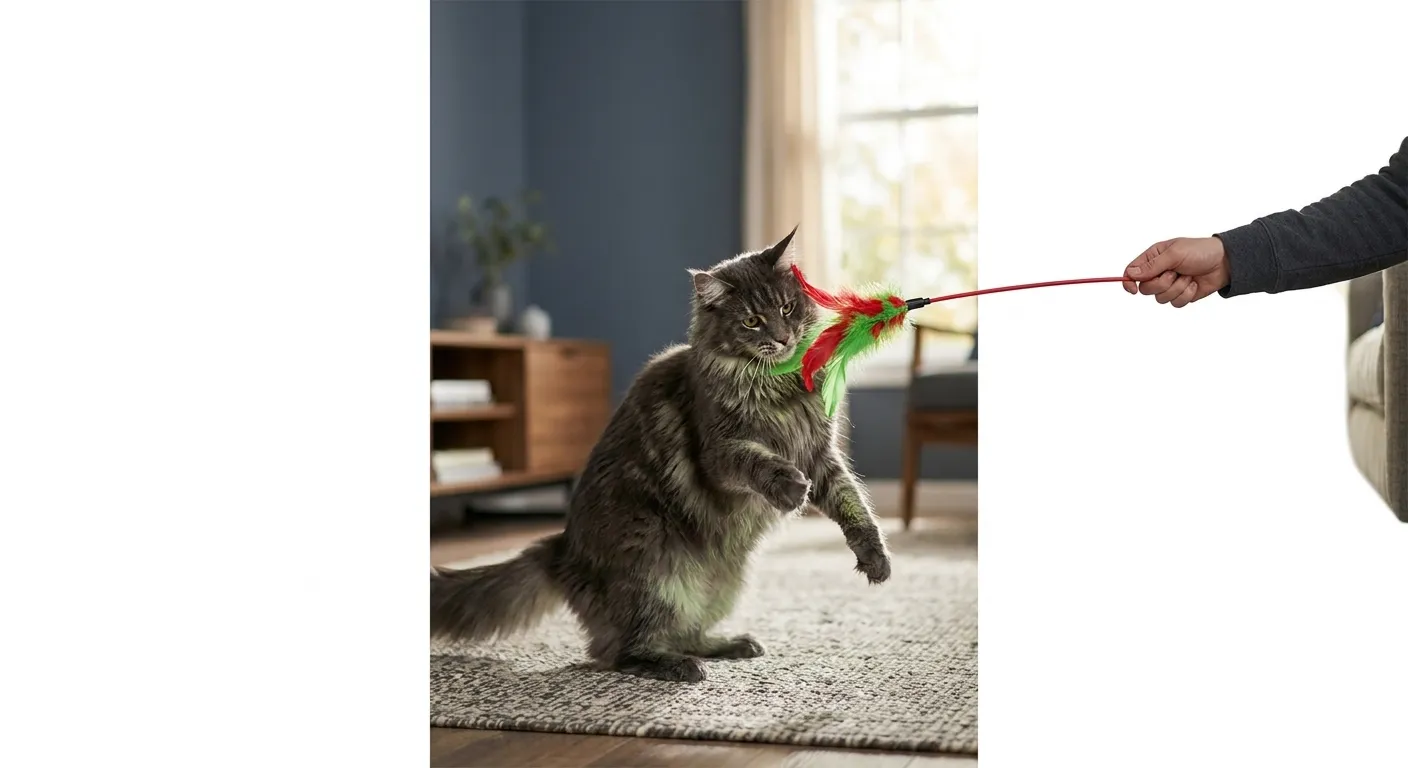
RSPCA’s play resource describes movement with a wand toy to allow stalking, chasing and catching. Use an appropriate item under supervision and keep the movement manageable for your cat. Do not interpret the activity as a prescribed workout or require a high jump to make the session worthwhile.
Prepare a clear play area with secure footing. Begin with a movement the cat can investigate comfortably and allow a pause. Observe whether it follows, watches or leaves. If the activity becomes frantic or the item catches on something, stop and reset the arrangement rather than increase the movement to keep attention.
Inspect the attachment afterward and store the item as instructed. A loose string or damaged component should be addressed before the next session. Do not lend a toy to another animal without checking its suitability again. The card you made can help a sitter run the same appropriate supervised activity.
Make food puzzles an accessible feeding task
Ask your vet whether a food puzzle suits the feeding plan and how to count the food used. Use an appropriate portion rather than add rewards outside the agreed allowance. A puzzle marketed for weight management does not replace a veterinary plan or prove that it changes the cat’s weight.
Begin with a task the cat can access easily. Show where the suitable food is available without forcing a paw or face into the equipment. Observe whether the cat can use the mechanism and whether food remains available as intended. An unsuccessful attempt should lead to a simpler setup or a professional question, not withholding meals until the cat solves it.
Check the maker’s cleaning instructions and whether the chosen food format is supported. A toy suitable for dry pieces may not be intended for another food texture. Clean and dry the equipment as instructed, and record any access problem. Ease of use includes the caregiver’s ability to maintain it appropriately.
Evaluate electronic toys before relying on them
Read the operating and supervision instructions for the exact device. Check how power, moving parts and accessories are managed. Do not assume that automatic means safe for unsupervised use. The first demonstration should occur while you can observe the cat and stop the equipment if the interaction is unsuitable.
Let the cat investigate the inactive item where appropriate before adding movement. Use the supported settings and keep an accessible retreat. If the movement or sound causes avoidance, stop rather than insist that the animal must adapt. A product video is a demonstration of that video’s animal, not evidence of your cat’s preference.
Record whether you can operate, clean and store the item comfortably. If the equipment adds complexity without an activity your cat chooses, it may not serve the task you selected. This is an individual practical judgement, not a claim that electronic toys are universally worse or better than ordinary toys.
Consider climbing and resting equipment separately
RSPCA’s home-environment guidance includes space for play, suitable high places, resting areas and hiding opportunities. A climbing structure can be part of the arrangement, but it requires its own assembly and suitability check. It is not interchangeable with a small interactive toy.
Read any loading, attachment and placement instructions from the maker. Inspect access routes, platforms and the surrounding area. Ask about suitability for your cat’s size and health when needed. Do not select a tall structure only because Maine Coons are described as large; the individual cat must be able to use the arrangement comfortably.
Keep resting access available without requiring a performance. A cat should not need to complete a difficult play task to reach its ordinary care resources. Observe whether other pets affect the route and discuss concerns with a professional. More equipment in one corner may not resolve an access problem elsewhere.
Compare practical use rather than a universal best score
Put candidate toys beside the task you chose. For each, record the supported use, required supervision, maintenance, storage and unanswered questions. Choose an item whose arrangement you can provide. Do not give a durability score from reviews you have not verified or claim that a particular material guarantees safety.
If you already have several suitable items, rotate what is offered when practical and observe the response. Keep a favourite usable item available when it fits the plan; novelty is not a compulsory daily target. Check condition before use rather than assume that familiarity makes wear harmless.
Finish a session with a clear care routine
After supervised play, inspect and store the equipment, account for food used and leave the cat’s normal rest and water arrangements accessible. Write one useful observation for the next session. A hypothetical note might be wand movement followed on the floor, but noisy mechanical toy avoided. That describes a comparison without inventing a result or making a health claim.
Maine Coon interactive toys should support activities your own cat chooses and can use comfortably. Begin with a play preference, check the exact equipment and try one manageable supervised session. Use the observation to select the next activity or ask for help. A practical routine matters more than claiming that a toy category guarantees a happy, healthy or better-behaved cat.