
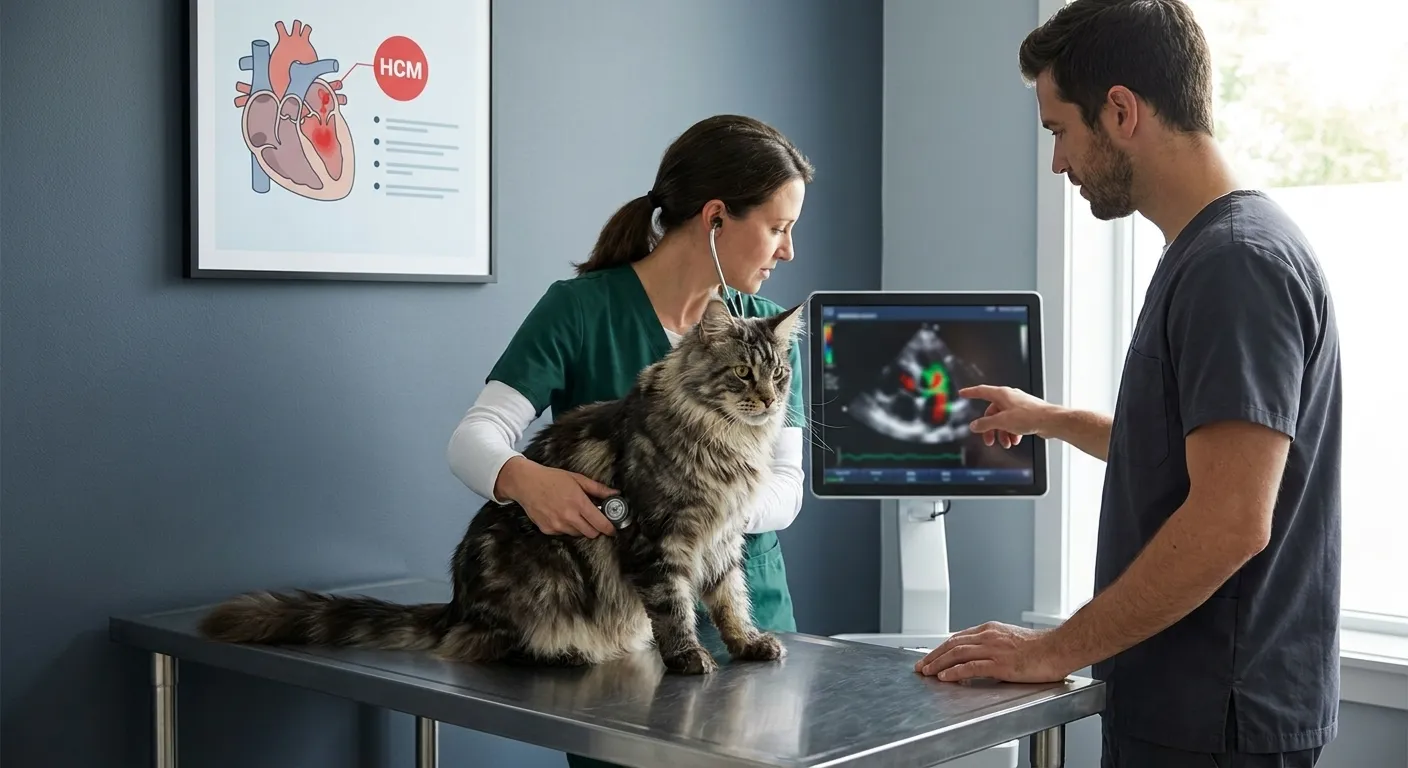
Maine Coon HCM facts can help you ask clear questions about your cat’s heart care. Hypertrophic cardiomyopathy, or HCM, involves thickening of the heart muscle. A genetic result, an apparently normal day at home and a clinical heart assessment provide different kinds of information. They should not be treated as interchangeable answers to whether a cat has the condition.
This is general information, not veterinary advice, a diagnosis or a treatment plan. Consult a qualified veterinarian about screening and care for your Maine Coon. Breathing difficulty, collapse or sudden painful weakness of the hind legs calls for urgent veterinary attention. Do not wait to complete a home log or genetic test when your cat appears seriously unwell.
Understand the condition without predicting an outcome
Cornell’s HCM guidance explains that thickened heart muscle can affect heart function and is associated with complications including heart failure and blood clots. Some affected cats do not appear ill. The effects and prognosis vary, so a general article cannot assign your cat an expected course or lifespan.
Use the definition to prepare the first question: what information do we have about this cat’s heart, and what still needs assessment? Ask the clinician to distinguish a concern found during an examination from a confirmed diagnosis. Keep the exact wording in your notes instead of converting possible disease into certainty.
Avoid comparing your cat with an online story and assuming that the same progression will occur. A story may involve a different diagnosis, stage or other health condition. Bring a question prompted by the story to the vet if it matters to you, but keep it separate from the findings recorded for your own cat.
Distinguish genetic screening from examining the heart
The UC Davis Veterinary Genetics Laboratory’s Maine Coon test concerns the A31P variant in MYBPC3 associated with HCM risk. The laboratory states that this test detects that particular mutation and discusses HCM occurring in cats without it. A result for the variant is therefore not a complete test for every cause of HCM.
Take the full report to the veterinarian. Ask which variant was tested, what the recorded result means and how it fits the clinical assessment. Do not reduce the report to heart healthy or definitely will develop disease. Ask the clinician to explain the difference between genetic risk information and a finding in the heart itself.
If a breeder supplies parental results, check the animal identification, test name and date. Those reports describe the tested parents; they are not automatically a clinical assessment of your kitten. Keep the original documents available and ask your vet how to use them when planning care for the individual cat.
Prepare for the clinical assessment
Cornell explains that echocardiography uses sound waves to image the heart and that other causes of thickening, including high blood pressure and hyperthyroidism, need consideration. Ask your vet which examination or tests are appropriate and whether a specialist referral is indicated. A home photograph or consumer device cannot provide that clinical interpretation.
Before the appointment, collect the cat’s identification, prior veterinary records, existing test reports and current medicine or supplement list. Include the full product name and instructions actually being followed. If you do not know a detail, mark it unknown rather than fill the gap with a guess from another animal’s prescription.
Ask the clinic how to prepare for the visit. Follow its instructions on food, transport and any existing treatment; do not invent a fasting rule from a general article. Tell the team if travel or handling is difficult so it can advise on a suitable arrangement. Keep the clinic’s contact details with the appointment note.
Ask what the report establishes
At the appointment, request an explanation in ordinary language. Useful questions include what was seen, whether the finding is definitive, what alternative explanations were considered and which next step is recommended. Ask for a copy of the report and the instructions that apply to your cat.
Separate three entries in your notes: confirmed finding, unanswered question and planned follow-up. This prevents an uncertain screening observation from becoming a settled diagnosis in the household’s care instructions. If the clinician recommends another test, write its purpose beside it rather than record only the appointment date.
Ask when and how to contact the team if the situation changes. A review date does not mean you should ignore a concern until that date. The clinician can explain which observations require prompt advice and which belong in the routine record. Repeat those instructions back if they are unclear.
Use an individual home-observation plan
If your vet asks you to monitor an observation at home, request a demonstration and the specific action threshold for your cat. For example, ask how to make the observation, when to make it and what to do with the result. Do not adopt a breathing-rate cutoff or examination technique from another cat’s care plan.
Prepare a short log with date, observation, circumstances and the action taken. Record whether the cat was resting or active if the team asks for that context. A measurement without the relevant circumstances can be difficult to interpret. Do not repeat handling that disturbs the cat simply to produce a more complete-looking record.
Keep observations distinct from explanations. Cat rested in a different place is an observation; heart disease worsened is a clinical conclusion the note does not establish. Bring the actual detail to the team. A useful home record supports its assessment rather than substitutes for it.
Know when the routine stops
Cornell describes laboured or open-mouthed breathing and acute painful hind-limb problems among serious signs associated with HCM complications. These observations are not proof of one diagnosis, but they warrant urgent veterinary attention. Call the emergency service and follow its instructions instead of continuing a home assessment.
Keep the regular and after-hours clinic contacts available to all caregivers. Ask in advance how to reach the appropriate service in your area. If your cat becomes seriously unwell, explain the observed signs and any existing diagnosis or medicines clearly. Do not delay travel or professional advice to capture a perfect video.
Make transport arrangements that follow the team’s advice. Avoid an improvised exercise test, forced feeding or unprescribed treatment while waiting. The emergency call is for instructions appropriate to the situation. A general guide cannot decide what the animal needs at that moment.
Follow the prescribed care rather than a general recipe
Ask the treating veterinarian what each prescribed treatment is intended to address and how it should be given. Keep the exact written instructions, including the plan for missed doses or difficulties, if supplied. Do not share another pet’s medicine or alter a prescription after reading a forum account.
If giving treatment is difficult, tell the team what happens: the cat refuses the method, an item cannot be measured as instructed or a caregiver is unsure about timing. Ask for an appropriate adjustment or demonstration. A problem carrying out the plan needs clarification, not a silent change made at home.
Bring diet, supplements and activity questions to the same team. Do not assume that a heart-labelled supplement treats HCM or that a restrictive diet is automatically required. The plan should reflect the clinician’s assessment and any other health needs. A product’s marketing language should not rewrite it.
Share a clear care card with helpers
Prepare one current card containing the clinic contacts, confirmed diagnosis if any, prescribed instructions, observation method and next review. Date it so a sitter can distinguish it from an older version. Keep the full reports elsewhere but make them available when the clinic needs them.
Tell helpers which concerns should prompt a call and who is authorised to speak with the veterinary team. Explain the familiar transport arrangement. Do not expect a caregiver to interpret a genetic code or heart scan independently. They need practical instructions for this cat and a way to obtain help.
Maine Coon HCM facts are most useful when they clarify the next conversation. Bring complete reports, distinguish variant testing from clinical findings and follow an individual monitoring and treatment plan. Keep urgent contacts ready and report concerning changes promptly. You can support your gentle giant with accurate information and practical care without promising that a screening result or routine guarantees a particular outcome.