If you have ever questioned your cat’s origins, learning the maine coon purebred signs can help you better understand what makes this breed unique. Maine Coons are known for their impressive size, striking appearance, and friendly personality, but not every cat with similar features is truly purebred. Many mixed cats share certain traits, which makes identification more challenging than it first appears.
While appearance plays a big role, it is not the only factor to consider. Genetics, behavior, and even growth patterns contribute to determining whether your cat is purebred or mixed. Therefore, looking at multiple characteristics together provides a clearer picture. Once you understand these details, you can confidently assess your cat’s background and care for it accordingly.
Interestingly, even experienced owners sometimes misidentify their cats. That is why recognizing maine coon purebred signs requires attention to detail rather than relying on one obvious feature. As you explore the key traits, you will begin to notice how subtle differences can reveal a lot about your cat’s lineage.
Physical Traits That Define The Breed
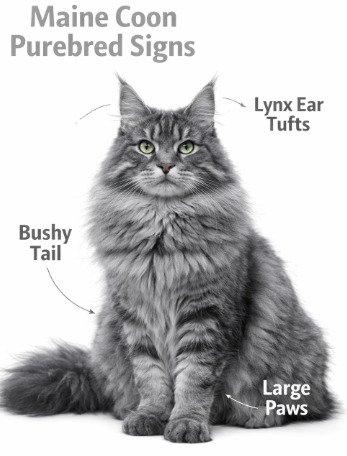
One of the most reliable maine coon purebred signs is the cat’s physical structure. Purebred Maine Coons are large and muscular, with long bodies and broad chests. Their overall build appears balanced and powerful, rather than bulky or overweight. In addition, their legs are strong and slightly longer in the back, giving them a distinct stance.
The head shape is another important detail. Maine Coons typically have a square muzzle and high cheekbones. Their facial structure looks defined and slightly angular, which sets them apart from many other breeds. Meanwhile, mixed cats may have softer or rounder features that lack this signature shape.
Ears also provide useful clues. Purebred Maine Coons have large, pointed ears with noticeable tufts at the tips. These “lynx tips” are a classic feature, although not every purebred will have them prominently. Still, they remain one of the most recognizable maine coon purebred signs when present.
The tail is equally distinctive. Maine Coons have long, bushy tails that often match the length of their body. This feature not only enhances their appearance but also serves a practical purpose, helping them stay warm in colder climates.
Coat Texture And Patterns
Another way to identify maine coon purebred signs is by examining the coat. Maine Coons have a thick, water-resistant coat that feels slightly silky rather than fluffy. This texture allows them to adapt well to various environments while maintaining a sleek appearance.
Their fur is longer around the chest, forming a noticeable ruff. Additionally, the coat is shorter on the shoulders and gradually lengthens toward the belly and tail. This uneven distribution creates a natural, layered look that is difficult to replicate in mixed breeds.
Color and pattern can vary widely. Maine Coons come in many colors, including tabby, solid, and bi-color variations. Therefore, coat color alone does not confirm purity. However, when combined with other maine coon purebred signs, it helps complete the overall picture.
Grooming needs also reflect coat quality. Purebred Maine Coons require regular brushing, but their fur is less prone to matting compared to some other long-haired breeds. This characteristic can offer another subtle clue about their lineage.
Behavior And Personality Traits
Beyond physical features, behavior provides strong insights into maine coon purebred signs. Maine Coons are often described as “gentle giants” due to their friendly and sociable nature. They typically enjoy interacting with people and adapt well to family environments.
Unlike many cats, Maine Coons tend to follow their owners around the house. They are curious and playful, yet not overly demanding. This balanced personality is a hallmark of the breed and helps distinguish them from more independent or aloof cats.
Another interesting trait is their vocalization. Maine Coons are known for their soft chirps and trills rather than loud meows. This unique communication style is often considered one of the subtle maine coon purebred signs that owners notice over time.
However, behavior alone is not definitive proof. Mixed cats can also display similar traits, especially if they share some genetic background with the breed. Therefore, combining behavioral observations with physical characteristics gives a more accurate assessment.
Growth Patterns And Size Indicators
Growth patterns offer additional clues when identifying maine coon purebred signs. Purebred Maine Coons grow slowly compared to most domestic cats. While many cats reach full size within a year, Maine Coons may continue growing for up to four years.
Their size is one of their most impressive features. Adult males can weigh between 15 and 25 pounds, while females are slightly smaller. However, size alone does not confirm purity, as some mixed cats can also grow quite large.
What matters more is the combination of size and structure. Maine Coons have long, rectangular bodies and sturdy bone structure. Their weight is evenly distributed, creating a balanced and athletic appearance rather than excess bulk.
Tracking your cat’s growth over time can help you identify patterns that align with maine coon purebred signs. If your cat shows gradual, extended growth along with other traits, it may indicate a stronger connection to the breed.
The Role Of Pedigree And Documentation
While physical and behavioral traits are helpful, official documentation provides the most reliable confirmation of maine coon purebred signs. A pedigree certificate traces your cat’s lineage and verifies its status as a purebred.
Reputable breeders typically provide this documentation when selling a purebred cat. Without it, determining purity becomes more challenging, even if the cat displays many typical features.
DNA testing is another option for those seeking clarity. Although not always necessary, it can provide additional insight into your cat’s genetic background. This approach is especially useful when documentation is unavailable.
However, it is important to remember that a cat’s value does not depend solely on being purebred. Mixed cats can be just as loving and healthy, even if they do not meet all the criteria for maine coon purebred signs.
Common Misconceptions About Maine Coon Cats
Many myths surround the identification of Maine Coons. One common misconception is that all large, fluffy cats are Maine Coons. While size and fur are important, they are not enough to confirm the breed.
Another misunderstanding involves ear tufts. Although they are a classic feature, not all purebred Maine Coons have prominent tufts. Therefore, relying on a single trait can lead to incorrect conclusions.
Additionally, some people believe that personality alone can determine purity. While Maine Coons are known for their friendly nature, behavior can vary widely among individual cats. This means personality should always be considered alongside other maine coon purebred signs.
By understanding these misconceptions, you can approach identification more accurately and avoid common mistakes.
How To Confidently Identify Your Cat
To confidently assess your cat, you should evaluate multiple factors together. Start by observing physical traits such as body structure, ear shape, and tail length. Then consider coat texture, growth patterns, and behavior.
Next, compare your observations with known maine coon purebred signs. If your cat matches most of these characteristics, it may have strong ties to the breed. However, without documentation, it is difficult to confirm complete purity.
Consulting a veterinarian or breed expert can also provide valuable insight. They can help identify specific traits and guide you toward a more accurate conclusion.
Ultimately, the goal is not just to label your cat but to understand its needs better. Whether purebred or mixed, every cat deserves proper care, attention, and a loving environment.
Conclusion
Learning to recognize maine coon purebred signs gives you a deeper understanding of your cat’s identity and characteristics. While physical traits, behavior, and growth patterns all provide valuable clues, no single factor can guarantee certainty without official documentation.
By combining observation with knowledge, you can make a more informed assessment of your cat’s background. At the same time, it is important to appreciate your cat for who it is, regardless of its lineage. Purebred or mixed, every cat brings unique qualities that make it a cherished companion.
With the right approach, you can focus on providing the best care possible while enjoying the special bond you share with your feline friend.
FAQ
- How can I tell if my cat is part Maine Coon?
Look for physical traits like a long body, tufted ears, and a bushy tail, along with a friendly personality. - Do all Maine Coons have ear tufts?
No, some may have less noticeable tufts, so it should not be the only factor you consider. - Is size enough to confirm a Maine Coon?
Size helps, but it is not enough on its own since many mixed cats can also grow large. - Can behavior indicate breed type?
Behavior offers clues, especially if your cat is sociable and gentle, but it should be combined with physical traits. - Is DNA testing necessary to confirm breed?
It is not required, but it can provide additional clarity if you do not have pedigree documentation.